


|
Today I had the privilege of participating in the 2nd Annual Local Author Fair sponsored by independent bookstore Mysteryscape in Overland Park, Kansas. The event hosted more than a dozen local authors signing and selling their books. I participated in the inaugural event last year and was pleased to be invited back again.
I sold seven copies of my Otter and Arthur books and enjoyed the conversation with other local authors, many of whom I remembered from the year before. It is wonderful to see a local, independent bookstore supporting local, independent authors. While it seems like an obvious fit, there are times when the former doesn't support the latter. I'm grateful for Mysteryscape and its support of local authors. |
 |

Showing posts with label Otter and Arthur and the Round Table. Show all posts
Showing posts with label Otter and Arthur and the Round Table. Show all posts
Saturday, December 13, 2014
2nd Annual Local Author Fair at Mysteryscape

Monday, December 1, 2014
National Novel Writing Month Winner, 2014

Woo hoo! For the second time, I've become a National Novel Writing Month (NaNoWriMo) winner. For those not in the know, NaNoWriMo is, as it says on its website, "a fun, seat-of-your-pants approach to creative writing. On November 1, participants begin working towards the goal of writing a 50,000-word novel by 11:59 PM on November 30."
I first dipped my toe into the NaNoWriMo pool in 2012, successfully scribing my rough draft of what became Otter and Arthur and the Round Table, my sequel to my middle-grade fiction Otter and Arthur and the Sword in the Stone.
I gave it another stab in 2013, but came up just short on my word count as I toiled away on Abigail's Atlantis, a still unfinished middle-grade fiction. The story bounces back and forth between a twelve-year-old girl's summer working with her grandfather at a sea turtle rescue center and a twelve-year-old boy's life in modern-day Atlantis. The latter may or may not be all in Abigail's head.
Although I'm not done with that book, when November 2014 rolled around, I couldn't resist taking another shot. I'd been hit with a recent brainstorm - an adult historical fiction based on the real life of blues singer Robert Johnson. Let's hope that 2015 sees the completion of that book, and/or Abigail's Atlantis. In the meantime, thanks to NaNoWriMo for providing the catalyst for me to jump in and crank out rough drafts of my hopefully someday completed novels.
Thursday, January 2, 2014
Otter and Arthur and the Round Table now available!

You can buy signed copies directly from me by clicking on the button below. Copies are $12.00 each with NO postage & handling charges or taxes.
The book is also available from Amazon, but is priced at $12.95 and will still having postage & handling and taxes added to the price.
Thursday, November 14, 2013
Penguins and Portals: Chris Baty Discusses the Origins of NaNoWriMo

image from shenandoahliterary.org
For those not in the know, November is National Novel Writing Month, aka NaNoWriMo (learn more at NaNoWriMo.org). I participated last year and wrote the first draft of my just-published Otter and Arthur and the Round Table.
The idea is to write a very rough draft of a 50,000-word novel in the month of November. I'm participating again this year with the intent of penning the rough draft of Abigail's Atlantis, my story of a 12-year-old girl who visits her grandparents at Topsail Island, North Carolina, for the summer. She helps her grandfather at the sea turtle rescue center where he works - and finds what she thinks is a connection to a modern-day Atlantis.
The point of this post, however, isn't just to plug my projects, but to talk about NaNoWriMo. I had the privilege last night of being one of roughly sixty people to see Chris Baty, the founder of NaNoWriMo. Originally from Prairie Village, Kansas, he was back in town to offer a history of how the organization came about and where it has gone.


images from jocolibrary.org and eiseverywhere.com
He started it in San Francisco in 1999. He tapped his friends to help with his crazy new idea and 21 people signed on board. It was up to 140 by the next year and ballooned to 5000 by the third year. Now in its 15th year, there are more than 300,000 participants as well as 1000 classrooms.
Baty possesses the rare talent of being a writer who also knows how to engage an audience. He talked about his own love of books and how they inspired his imagination. He shared how he loved The Lion, the Witch, and the Wardrobe as a kid and would go into the closet at home and search for a portal.
He relayed this experience to writing and how that opens a portal to one's own mind. He also joked about interviews with authors where they are asked questions like, "Where did you come up with the idea for the penguin?" and how the response was inevitably, "The penguin found me." As silly as he said that sounded, he realized how true it was once he began writing. Once the penguin found him, he knew the writing portal was open and would never close again.
Thanks, Chris Baty, for opening the portal for so many of us. Let the penguins rule!

Found: One Penguin. Considered Armed with the Ability to Inspire.
image from clker.com
Wednesday, October 9, 2013
Otter and Arthur sequel coming soon!

image from Merlin BBC series as posted on wikia.com
The sequel to Otter and Arthur and the Sword in the Stone is coming soon! Here's a sample from Otter and Arthur and the Round Table:
Once we were a safe distance from Morgan’s castle, Ferdinand landed so we could reposition ourselves on his back. “That was incredible!” Dindra whooped. “Do you two live like this all the time?”
Ferdinand and I smiled at each other. “To be honest,” I confessed, “it has been awhile since we’ve had any big adventures.”
Dindra looked bewildered. “King Arthur? Camelot? Merlin? Flying on a falcon’s back?” She patted Ferdinand. “How could life ever be boring?”
“Well, it just got interesting again recently,” I answered over my shoulder. Dindra, who had her arms wrapped around my waist, squeezed a little tighter and smiled.
We arrived at Stonehenge just as the sun was rising. “That,” said Dindra breathlessly, “is the most amazing sight I’ve ever seen.”
“No people – and few animals – get a bird’s eye view of this,” Ferdinand replied. Dindra and I laughed.
The stones were as tall as four men standing on each other’s shoulders. An outer circle wrapped around five sets of larger stones. A vast empty field surrounded the massive monument. “How do you think humans moved those huge rocks?” Dindra wondered aloud.
I shook my head in amazement. “I don’t know. Just think, though. The same creatures who made this also invented war.”
“Sometimes it is hard to believe people think they’re smarter than us,” Ferdinand added.
He floated down and landed on one of the larger rocks in the center. I smiled upon seeing the two people who gave me hope for humanity: the sleeping figures of Arthur and Merlin. They had set up camp in the middle of the stone circle. A few glowing embers lingered from a campfire and two sleeping horses were tied to a smaller rock nearby.
As I pondered some clever way to wake Arthur, Merlin sat up and looked straight at us and smiled. He seemed pleased, but unsurprised to see us.
Ferdinand flapped down and Merlin patted him on the head. “Good morning,” the wizard said. “You two must have had quite the adventures.” Then he noticed Dindra. “Make that three.”
“Who are you talking to, Merlin?” Arthur sat up and rubbed his eyes. “Otter!”
I rushed to the king and gave him our traditional thumb-hug greeting. “What happened?” he asked. “What took you so long to get here? Are you okay?” Before I could answer, he raised an eyebrow and said, “I see you’ve got a friend with you.”
I introduced Dindra and told Arthur and Merlin how she saved my life. However, I was focused on the urgency of our situation.
“We have to get back!” I exclaimed. “Lot’s going to attack Dragon’s Head and take over Camelot!”
Merlin smiled, looking unalarmed. “Sometimes when the perceived need is to hurry the best solution is to slow down.”
I was annoyed with Merlin for staying so calm. He’s probably had a vision of what’s going to happen, I thought.
He offered no explanation. Instead he gazed up at the orange hue slowly conquering the grey nighttime sky. “I believe I shall go for a ride. I’d like to enjoy the onset of this glorious day. Arthur, perhaps you can share your new idea with Otter.”
Arthur stirred the coals of the campfire. Dindra and I settled down on a nearby rock.
“Pretty amazing, isn’t it?” Arthur asked as he took a seat and gazed up at the stones surrounding us. “I bet you’re wondering why Stonehenge was built.” Dindra and I shook our heads and Arthur continued. “Merlin told me people think it is a place for healing or studying the stars.” He paused and got a serious look on his face. “Otter, this is where my father is buried.”
”Is that why Merlin brought you here?” I asked.
Arthur nodded. “My father saw Stonehenge as a symbol of power and strength. That’s the kind of ruler he wanted to be. However, here’s my idea.” Arthur pulled his pack toward him. “Dindra, you’ll be interested to know it was Otter who made me think of this.” He pulled a loaf of bread out.
I scratched my head. “Bread? That was my idea? How’s that going to make you a better leader?”
“No,” Arthur laughed. “I thought you two might be hungry.” He tore off two chunks and handed them to us. “This was Otter’s idea,” he said, retrieving a piece of parchment. He laid it down and smoothed it out. It was a sketch of Stonehenge.
“Stonehenge was my idea?”
“Well, Stonehenge looks like a giant table to me. It reminded me of your first visit to Dragon’s Tail. Your uncle called a meeting of all the mouse village residents at a round stage. It’s how I’m going to lead Britain.”
“From a round stage in a mouse village?” I munched on my bread and stared at Arthur.
“No,” he chuckled. He waved his arm at the huge rocks surrounding us. “One person didn’t do this alone. If I want to unite Britain, I can’t do that alone. I’ll invite knights and leaders to Camelot to work together. We’ll sit at a round table. At a rectangular table, someone sits at the head and automatically seems more important. At a round table, everyone is equal.”
Hmm… can’t do it alone. An idea was brewing about how I could get Excalibur back.
Check out details about the first book, Otter and Arthur and the Sword in the Stone at OtterAndArthur.com. You can buy it here:
Monday, September 30, 2013
Flora & Ulysses vs. Otter and Arthur: Which Didn't Win a Newbery?

image from suzyred.com
Okay, I'll acknowledge that one of these books is slightly better known than the other. Kate DiCamillo scooped up her second Newbery Award (given to distinguishd American children's literature, see full list of winners here) for Flora & Ulysses. She is the sixth author to win the prize twice. Stunningly, I have yet to win the award. ;)
Let's see if we can figure out why. Flora is a story of a child who wants a more interesting life and seeks out a relationship with her parents. When she rescues a rodent from certain death, the creature starts exhibiting amazing powers - such as the capacity to communicate with humans - and repays her ten-fold by helping her find the adventurous life she's always sought.

Hey, wait a minute. That's the plot of my first children's novel, Otter and Arthur and the Sword in the Stone. Oh sure, mine's only about a mouse who proves instrumental in giving King Arthur his legendary status while DiCamillo's book focuses on a squirrel who gets sucked up by a vacuum cleaner and then learns to type poetry.
Huh?
That's what I thought. In all seriousness, I the book left something to be desired. DiCamillo populates her series of Mercy Watson books with lovably quirky characters and amusingly silly plots, aided by great illustrations. By comparison, Flora is served by a quirky, but less-endearing cast in a more head-scratching tale. The book has some illustrations, but not enough to lift it the cartoonishly over-the-top, but fun antics of the Mercy Watson books.
I suppose I should concede that Kate DiCamillo is one of the best-known children's authors around. She's even had her books made into movies, including the Newbery-winning Tale of Despereaux and Because of Winn-Dixie. It would be nice to think my little self-published effort could rise above it all and, like the little engine that could or the story of David vs. Goliath, triumph over the big-time works backed by major publishers.
It would be nice, but I'm not counting on retiring on the vast amount of wealth I anticipate accumulating in the wake of my inevitable Newbery win. Sigh.
Saturday, December 1, 2012
National Novel Writing Month

image from laughingsquid.com
In November 2012, I participated in National Novel Writing Month, known as NaNoWriMo for short. The objective is to write the rough draft of a novel (50,000 words)in the month of November.
I've never been a steady, disciplined writer. The idea of writing a consistent 1500+ words a day was daunting. I hoped, though, that I could write in enough big spurts to pull it off.
My other challenge was hitting 50,000 words with one project. It just couldn't be done. My primary goal was to write the first draft of Otter and Arthur and the Round Table, which will be the sequel to Otter and Arthur and the Sword in the Stone. Learn more about those books at OtterAndArthur.com.
However, that posed a problem. The first book runs about 26,500 words. I wasn't looking to change the word count for the second so doubling the size of the book wasn't a real option.
That meant cobbling together a couple projects. I also write non-fiction books about music history and was in the early stages of an intended book called The Top 100 Albums of All Time. Learn more about that project at TheTop100AlbumsOfAllTime.com.

By tag-teaming the two books with some other smaller writing projects, I pulled it off! 52,045 words in 30 days. Woo hoo! I did it!

Tuesday, January 17, 2012
The One and Only Ivan: Making Characters Unique
With seven Newbery-award-winning books under my belt already, I finally read the 2013 winner, The One and Only Ivan, by Katherine Applegate.

image from betterinbulk.net
I've joked in previous posts that clearly the trick to winning a Newbery is to write a book about a tween or teen uprooted from his or her home because of some family tragedy. Applegate's book puts a spin on this formula - a gorilla named Ivan is uprooted from his home because of some family tragedy.
Ivan has been part of a mall circus exhibit, the Exit 8 Big Top Mall and Video Arcade, for 27 years. He has accepted his fate, but when Ruby, a baby elephant arrives, Ivan decides this is no place for an animal to spend its life. He concocts a plan. He is going to free Ruby so that she can grow up in a zoo with other elephants.
Applegate creates a unique character by telling the story from the first-person perspective of a gorilla. To that end, she has written in a short, choppy style with chapters rarely lasting more than a couple pages, and sometimes just a couple sentences.
The lesson for my own writing is to find a way to make a character unique. That isn't always as easy as writing from the persective of a gorilla, but uniqueness can be achieved because of a character's unique circumstances or unique perspective. In Otter and Arthur and the Sword in the Stone and its in-progress sequel, I have been able to tell the story of King Arthur from the perspective of a mouse. As I write my next story, Abigail's Atlantis, my challenge is to find what makes the main character unique.
It is the challenge all writers must undertake - give readers a new experience through the uniqueness of the character, the circumstances, or perspective. After all, if the story isn't unique, what is the point in telling it?
Tuesday, October 12, 2010
Musing Over Manifest and Mockingbird

Most of my visits to the library involve my kids. This is a good thing because I end up browsing the children's section. Recently I stumbled across the 2011 Newbery winner, Clare Vanderpool's Moon Over Manifest. As stated on the Association for Library Service for Children website, "the Newbery Medal is awarded annually by the American Library Association for the most distinguished American children's book published the previous year."

Having dipped my toe into the literary waters of middle-grade fiction with Otter and Arthur and the Sword in the Stone, it seemed appropriate to read some of the most celebrated works targeted at that age group. Manifest succeeds largely in that it is written such that it has as much, if not more, appeal for adults as it does kids.
Harper Lee's To Kill a Mockingbird often sprang to mind. Manifest lacks the powerful theme of that classic, but resembles it in how we see the town and its people through the eyes of a young girl trying to better understand her father. The two books also resemble each other in that kids are central figures, but that doesn't make these children's stories. Mockingbird deals with heavy themes and circumstances suggesting readers be at least teenagers. Manifest is so rooted in giving the reader a glimpse of history that it would have limited appeal to pre-teen readers, which makes me question somewhat what criteria Newbery uses to define something as a "children's book."
The lesson for me as a writer is the value of telling a story which appeals to children and adults. Otter and Arthur and the Sword in the Stone and its in-progress sequel, Otter and Arthur and the Round Table, are much less sophisticated stories. I deliberately kept the language and the plot simple to keep younger readers' interest. At the same time, I worked hard to infuse the stories with themes, characters, and scenarios to which adults would relate. Did I succeed? You'll have to stay tuned for the sequel (due in Autumn 2013), but you can check out the first book here:
Tuesday, July 14, 2009
When You Reach Me: Making Sure You Reach Readers with Satisfying Conclusions
This month I've launched my effort to plow through a healthy chunk of Newbery Award winners in my quest to get a bead on the best children's literature out there. I delved into Clare Vanderpool's Moon Over Manifest earlier this month (Musing Over Manifest and Mockingbird, 6 May 2013) and have now added Rebecca Stead's When You Reach Me to the list.
Rebecca Stead discusses When You Reach Me
With a whopping two under my belt now, I already see a pattern. These are slice-of-life tales. The main character in each book is a pre-teen girl learning to navigate the world around her, by understanding her family, making make friends, and grappling with the bigger pictures of life.
The two stories also involve mysteries. In Manifest, Abilene wants to learn about her father's childhood while in Reach Me the quest is to learn the identity of whoever is leaving secret notes. Manifest and Reach both engaged me in the overall stories and characters. However, the former did a little too much signposting and left me feeling a little letdown by the finale. The latter had peppered in the clues so that it all came together in the end, but I was still scratching my head a bit.
I have integrated some mysteries in my own endeavors writing Otter and Arthur and the Sword in the Stone and now fine-tuning its sequel, Otter and Arthur and the Round Table. The lesson is to make sure the reader will 1) want to learn the outcome and that 2) the reader will be satisfied with the outcome once it arrives. This means that the reader must be well-invested in the characters and the story, but also that the ending comes across neither as too signposted nor as too much of a surprise.
Sunday, June 30, 2002
Crispin...and Other Stories of Boys of Unknown Origin
In my effort to familiarize myself with Newbery-award-winning books, I just polished off Crispin: The Cross of Lead. The book, the 50th by the author Avi, explores the life of a peasant boy who must deal with the death of his mother and then fleeing the only village he has ever known after being accused of a crime he didn't commit.
His journey pairs him with a juggler known as "Bear." The man takes Crispin under his wing as a sort of apprentice, but it turns out the man will also lead Crispin to find out the identity of the father he never knew.
As now happens with every book I read, I inevitably find similarities to my own writing. In this case, Crispin shares a common storyline with Otter and Arthur and the Sword in the Stone. Avi's story focuses on an orphaned boy coming of age in medieval England and being led to his destiny with the help of a wise, but sometimes mysterious, man who takes a special interest in the boy. That, of course, is also at the essence of the origins of the story of King Arthur as Merlin guides the boy, unaware of his true identity, to his destiny.
While such commonalities in stories might suggest a lack of originality, there is another interpretation - good stories aren't necessarily original. They just find a way to put a fresh spin on the familiar. That may happen in the portrayal of character (I particularly enjoyed Bear), description of setting (I loved the detailed descriptions of the town of Great Wexly), or the ability of an author to capture a world set in another time.
As I slog through the second draft of Otter and Arthur and the Round Table, the sequel to the Sword in the Stone book, I am reminded of these challenges. I am telling a familiar tale, but must keep an eye on how to bring a freshness to the story via my characters, settings, and era. It certainly doesn't guarantee me a Newbery award like Avi got, but then I've got another 48 books to go before I have his resume.
Tuesday, December 31, 1996
The View from Saturday: Making Your Story a Fresh Idea
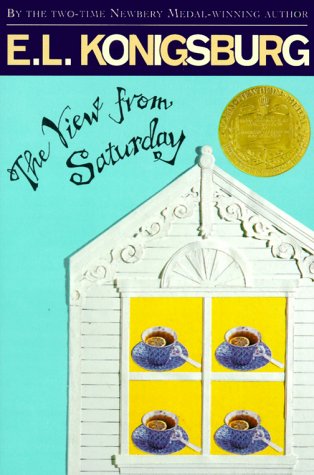
Uh oh. On page 31 of E.L. Konigsburg's The View from Saturday (Atheneum Books for Young Readers, 1996), I was hit with a sense of dread by two lines: "He was talking about turtle nests. Turtles had brought Grandpa and Margaret together."
Konigsburg's book tells the story of the four sixth graders who comprise Mrs. Olinkski's Academic Bowl team at Epiphany Middle School. The book explores how the four friends ended up together by devoting a chapter to each of their back stories. Twelve-year-old Nadia's back story involves a trip to Florida to see her dad - and spending time with her grandfather and his new wife on the beach looking for sea turtle nests.
So why would this cause dread? Because my latest project is the story of a twelve-year-old girl who goes to spend the summer with her grandfather looking for sea turtle nests.
Certainly there are differences. My book, Abigail's Atlantis, will focus on many different aspects of the sea turtle's habits and use it as the context for the entire story arch, not just integrate it into a single character's one-chapter back story. Still, there's a sense of discouragement when the idea you thought was original turns out not to be.
In writing two King Arthur-themed books so far (Otter and Arthur and the Sword in the Stone, Otter and Arthur and the Round Table), I have had to work hard to navigate this path. With Abigail's Atlantis, I already was tasked with coming up with a fresh spin on another topic. Now I have to find a way to give a new look to the sea turtle side of the story as well as the Atlantis side.
Note: for those who haven't read the book, this video collection of seemingly disjointed images and quotations won't make a lot of sense. However, in context, they capture the main themes and plots of the book.
Subscribe to:
Posts (Atom)