Showing posts with label King Arthur. Show all posts

Saturday, February 9, 2019

10 Books Which Impacted Me

First posted 2/9/2019.

These are the books which have most inspired me to read, write, imagine, and create. These titles span from childhood to adulthood, presented (as much as I can remember) in the order in which I discovered them.


A.A. Milne The Complete Tales of Winnie-the-Pooh (1994)

This is a packaging of Winnie-the-Pooh (1926) and House at Pooh Corner (1928), the two classics which introduced the world to Christopher Robin and Pooh, his stuffed-animal bear. Pooh is a self-admitted bear-of-very-little-brain, but his optimism and heart of gold modeled a way of life we should all try to emulate. In fact, Benjamin Hoff’s The Tao of Pooh (1982) is another favorite book of mine because of how well it captures the essence of Pooh in describing a philosophy of life.


J.R.R. Tolkien The Hobbit (1937)

In the summer after my sixth grade year, my family went down to Georgia for a week, as we did every summer. My grandmother was bed-ridden and a neighbor, feeling like my brother and I might be bored, brought over a box of books. I plucked The Hobbit from the stack. I’d heard of it, but didn’t know much about it. I devoured it that week – and many times after that throughout junior high and high school. Read a more in-depth review of the book here.


John Steinbeck Acts of King Arthur and His Noble Knights (1976)

This was Steinbeck’s adaptation of Sir Thomas Malory’s Le Morte d’Arthur (1485) and my introduction to King Arthur when I read it in English class in 8th grade. It led to a fascination with King Arthur, even resulting in me writing my middle-grade fiction series, Otter and Arthur, which retold the legends of King Arthur through the eyes of a mouse.


Harper Lee To Kill a Mockingbird (1960)

Like millions of others, I was exposed to this book as required reading in high school. Also like millions of others, I was completely drawn in by Lee’s powerful story about Scout, a young girl who comes face-to-face with racial discrimination in her small town – and recognizes her own prejudices in how she judges her reclusive neighbor, Boo Radley. Having re-read the book multiple times, I’ve come to be enamored with the story-telling style of the book and how it makes the small-town setting essential to the book. Read a more detailed review of the book here.


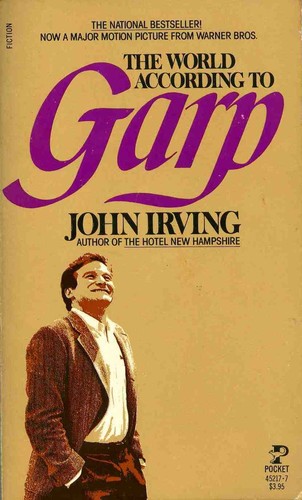
John Irving The World According to Garp (1978)

I saw the movie version of Garp when I was in high school. I watched it because I was a Robin Williams fan, but fell in love with the movie because of its quirky characters and unique story. I eventually read the book, which led me to devour everything Irving had written prior to that. Since then, A Prayer for Owen Meany has supplanted Garp as my favorite John Irving novel and one of my favorite books of all-time, but this was the one which introduced me to him as an author.


Joel Whitburn Top Pop Singles 1955-1996 (1997)

As a music chart fanatic, I was overjoyed when I found Whitburn’s Record Research company, which published books compiling chart data from Billboard magazine. The granddaddy of them all was this book, which gathered data for all songs to ever hit the Billboard Hot 100 pop chart and then listed them by the recording acts. Not only have I gone through multiple editions of this book, but I have gone on to line my shelves with other Record Research books covering rock, country, R&B, and album charts.


Otto Kroeger and Janet M. Thuesen Type Talk: The 16 Personality Types That Determine How We Live, Love, and Work (1989)

I dropped out of college in 1989, a semester-shy from graduating. It forced me to go to work and I stumbled into the afterschool arena. I soon realized that was what I wanted to do with my life and within a few years finished my degree. In that second time around, I was reinvigorated by having a career focus and specifically wanting to gain a better insight into personality types and how they affect learning. One of my professors steered me toward the Myers-Briggs Type Indicator and whetted an appetite in me for recognizing how people learn differently.


Dave Whitaker Games, Games, Games: Creating Hundreds of Group Games and Sports (1996)

Sometime in the mid-‘90s, my supervisor recommended I go to the airport to meet Rich Scofield, a publisher in the afterschool arena. I showed him the game activity book I’d created for work and he told me it could practically be published as it was. This was not only the first of some twenty-something books I’ve now published (see my author page at Amazon), but sowed the seeds for me to start my own company, Toolbox Training, focused on providing resources, training, and consulting to afterschool programs.


Dave Marsh Heart of Rock and Soul: The 1001 Greatest Singles Ever Made (1989)

The Whitburn books fed my interest in charts. This book fed my interest in collecting lists which ranked songs without consideration to chart performance. It led to the creation of my Dave’s Music Database website and my own self-published, list-oriented books, including The Top 100 Songs of the Rock Era, 1954-1999, The Top 100 Albums of All Time, and The Top 100 Songs of the Pre-Era, 1890-1953.


Howard Gardner Frames of Mind: The Theory of Multiple Intelligences (1983)

My undergraduate degree was marked by my fascination with Myers-Briggs. My pursuit of a Masters in Education in the early 2000’s was marked by my discovery of Howard Gardner’s theory of multiple intelligences. Like Myers-Briggs, it had important implications on my understanding of how people learned differently – and deserved to be understood as individuals. My final thesis resulted in my second published book, Multiple Intelligences & After-School Environments: Keeping All Children in Mind (2002).

Wednesday, November 28, 2012

Otter and Arthur on TV!

On November 28, 2012, I appeared on the KCTV5 television show Better Kansas City (airing from 9:00am to 10:00am CST). I was interviewed about my book, Otter and Arthur and the Sword in the Stone and discussed the writing and publishing process.

Here's a detailed version of the interview with links included:

How did the book come about?
I’ve been a fan of King Arthur since I was a teenager. I wanted to share the stories with my kids, who are 10 and 7. However, books about King Arthur tend to be the equivalent of R-rated movies so I decided to write my own age-appropriate version. I focused on the young Arthur and how he is befriend by a mouse nicknamed Otter. This mouse is responsible for Arthur fulfilling the legend of pulling the sword from the stone and becoming king.

Where can people find the book?
The book is available through OtterandArthur.com and at Shawnee Books & Toys.

What advice do you have for wannabe writers?
Write, write, write. Don’t worry about whether it is good. Don’t worry about how many words you write each day. Don’t worry about whether you have your idea fleshed out. Don’t worry about editing. Just write. Get your ideas down on paper. The rest will come later.

So how you stick it out and finish a book?
I recommend finding a writers’ group. I joined one I found through Meetup.com (The Kansas City Writers Meetup Group) by just searching for writers’ groups in the Kansas City area. The advantage of such a group is having a support system. They keep you focused and give valuable feedback to help you fine-tune and finish.

Your book is self-published. Why did you go that route instead of a traditional publisher?
The traditional route is a long and hard journey. One must write query letters to try to get agents, expect to get rejected many times over, and – even in the best case scenario, be prepared for a couple years to go by before the book is published. Even then, there’s no guarantee how much marketing power a publishing company will put behind the book.

What are the advantages of self-publishing?
I can get the book out there as fast as I want and I make all the decisions. For this book, I hired professionals to edit it and do the book design, but someone could even do that themselves.

So how does one get self-published?
I use CreateSpace.com. It costs nothing, is easy to use, and is affiliated with Amazon. You upload a jpeg cover and a pdf file of the book’s content. The book lists on Amazon as a print-on-demand title which means the author can order one copy or a hundred. You can also create an ebook version for Kindle.

Click on any of the above icons (CreateSpace, Amazon, Kindle) to go to those sites and purchase Otter and Arthur and the Sword in the Stone. You can also click on the "Buy the Book" tab on this site.


Follow Writ by Whit or Otter and Arthur on Facebook for more about writing and this book in particular.

Tuesday, December 31, 1996

The View from Saturday: Making Your Story a Fresh Idea

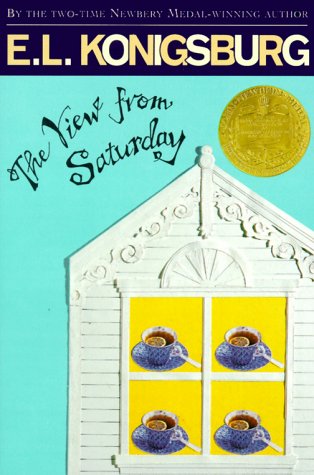
Uh oh. On page 31 of E.L. Konigsburg's The View from Saturday (Atheneum Books for Young Readers, 1996), I was hit with a sense of dread by two lines: "He was talking about turtle nests. Turtles had brought Grandpa and Margaret together."

Konigsburg's book tells the story of the four sixth graders who comprise Mrs. Olinkski's Academic Bowl team at Epiphany Middle School. The book explores how the four friends ended up together by devoting a chapter to each of their back stories. Twelve-year-old Nadia's back story involves a trip to Florida to see her dad - and spending time with her grandfather and his new wife on the beach looking for sea turtle nests.

So why would this cause dread? Because my latest project is the story of a twelve-year-old girl who goes to spend the summer with her grandfather looking for sea turtle nests.

Certainly there are differences. My book, Abigail's Atlantis, will focus on many different aspects of the sea turtle's habits and use it as the context for the entire story arch, not just integrate it into a single character's one-chapter back story. Still, there's a sense of discouragement when the idea you thought was original turns out not to be.

For anyone who has read through my journey through the Newbery Award winning books, they know I've harped on how often orphans are at the center of these books. The key, of course, is that the task of any writer is to bring a fresh spin or perspective to a story, even if it is one which has been told before.

In writing two King Arthur-themed books so far (Otter and Arthur and the Sword in the Stone, Otter and Arthur and the Round Table), I have had to work hard to navigate this path. With Abigail's Atlantis, I already was tasked with coming up with a fresh spin on another topic. Now I have to find a way to give a new look to the sea turtle side of the story as well as the Atlantis side.

Note: for those who haven't read the book, this video collection of seemingly disjointed images and quotations won't make a lot of sense. However, in context, they capture the main themes and plots of the book.