Showing posts with label Atlantis. Show all posts

Tuesday, September 30, 2008

The Graveyard Book: Location, Location, Location

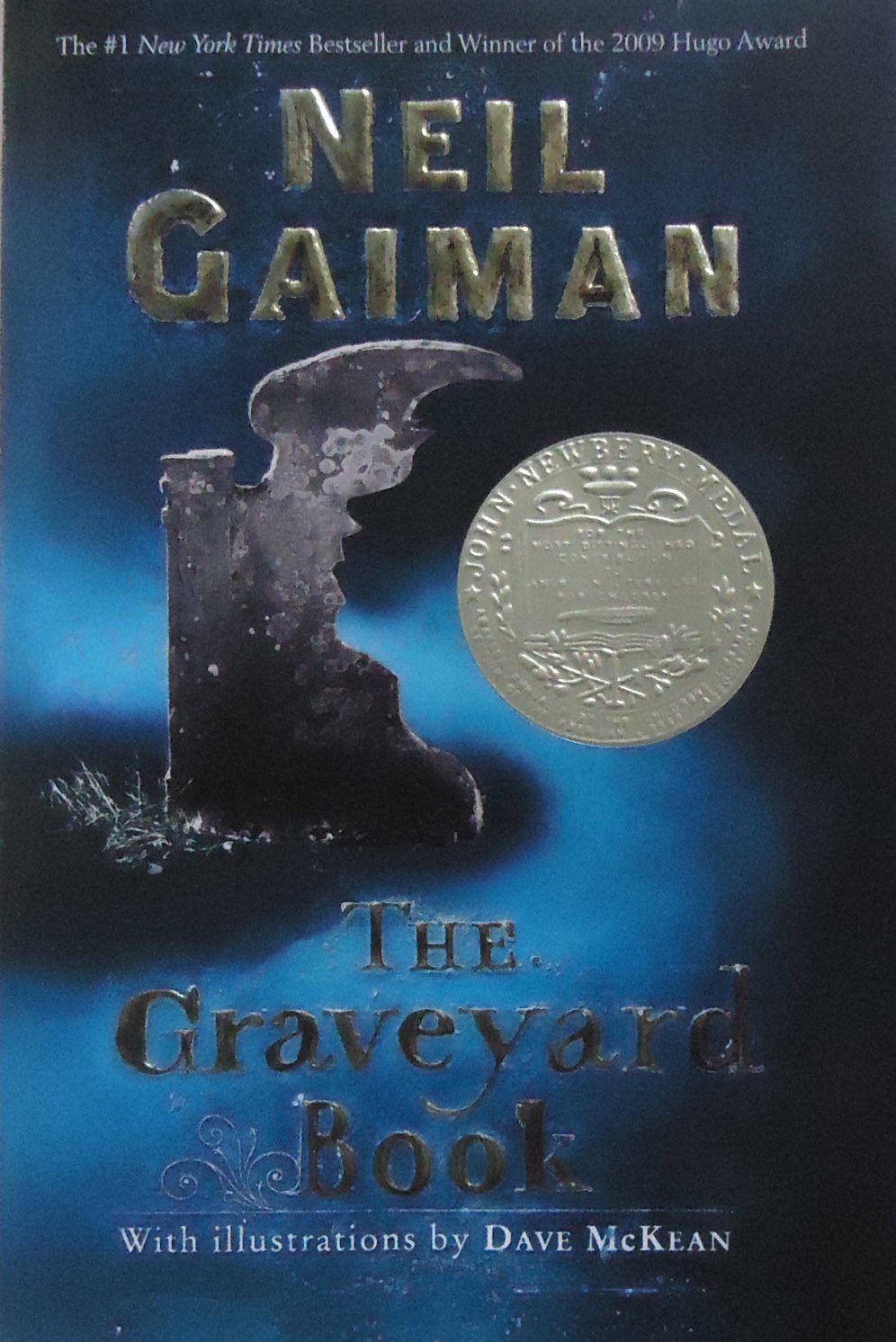
I've knocked off yet another book in my continuing endeavor to read the Newbery award-winning books. This time around it is Neil Gaiman's The Graveyard Book (2010). As with the previous Newbery books I've read, I focused on what I can learn in my own writing from this book.

The opening of the book leaves a toddler abandoned thanks to a grisly murder scene. He wanders out of his out, losing his diaper along the way, and ends up at the local graveyard. While the scenario is preposterous, it sets up one of the more interesting settings I've read in the Newbery winners so far. The boy (nicknamed "Bod" for "Nobody") ends up raised by a collection of interesting ghosts and undead creatures. While he appreciates his home, he longs for a life among the living - and he wants to find out what happened to his family.

However, we are left wondering through most of the book why Bod's family was murdered and when the answer comes, it is abrupt and unsatisfying. As for Bod's dream of a life outside the confines of tombstones and crypts, this is also undermined by the author. Gaiman clearly relishes describing the world of the dead and ends up making the world from which Bod wishes to retreat more interesting than the one to which Bod dreams of going.

Thus the lesson I learn about writing is to make setting and location an important part of the book, but not one which overwhelms the story. My latest project, tentatively titled Abigail's Atlantis, will delve into the ocean and the famous lost underworld city. It will become crucial to make sure that while I try to capture the wonder and awe of such a fabled location, I don't do it at the expense of creating a moving and involving story.


Monday, September 24, 2007

Good Masters! Sweet Ladies!: Voices from a Medieval Village - and Mastering a Single Voice in Your Story

In my exploration of Newberry winners, the 2008 winner, Good Masters! Sweet Ladies!: Voices from a Medieval Village, has me baffled. It is not my intent to read the Newbery winners with a smug "I can write better than that" tone, but rather to see what can be learned from these award-winning works.

That's proving a bit of a challenge with Masters. It isn't a story. It is a collection of mostly monologues and occasional dialogues crafted by school librarian Laura Amy Schlitz. When her students were studying the Middle Ages, she took it upon herself to craft these bits for reading aloud.

Each piece focuses on one or two characters who live within a medieval village. Occasionally characters overlap as secondary references in other pieces, but mostly each piece stands alone. That means we get dozens of perspectives of what it is like to live in a medieval village - we hear from the blacksmith's daughter, the miller's son, the glassblower's apprentice, and the beggar. These different voices go a long way in fleshing out what a medieval village might be like.

The biggest strength of this book is also its greatest weakness - by giving voice to dozens of characters, there is no one character on which to focus attention. That means this becomes a good exercise in teaching children about medieval history and its people, but not such a great exercise in getting children to love the story itself. Because there isn't one.

I definitely learned an important lesson from this book - the value of researching another era to get the characters and setting correct. That is relevant to my Otter and Arthur books - both the already published Sword in the Stone and the upcoming Round Table sequel. For both of those books, I have read extensively about the true history of King Arthur as well as the popular legendary variations of his story.

However, in the end, the story comes first. My goal with those books was to follow the well-established Arthurian tradition of shaping the popular legends to my agenda. I want to deliver an intriguing story and important messages to kids within an Arthurian context, but am not aiming for historical fiction.

I'm also at the very beginnings of another project in which a mix of fact and fiction will become very relevant. My as-yet-untitled Atlantis-themed children's novel will tell the story of a 12-year-old girl spending the summer at the beach with her grandparents. She becomes fascinated with Atlantis when she and her grandpa rescue a sea turtle with a tracking device which leads to a seemingly impossible conclusion - that this turtle has delivered a message from the ancient sunken city of Atlantis.

I have already done extensive research on Atlantis, Poseidon, sea turtles, sea turtle rescue centers, and Topsail Island (the North Carolina setting for the story). My goal is to make the story feel as real as possible.

This is all my way of emphasizing that research can be crucial to telling a story effectively. However, the story comes first. A book like Masters forgoes the balance in favor of showcasing the research without really telling a singular, unifying story.


Tuesday, October 31, 2000

A Year Down Yonder - and Another Novel from Me a Year from Now?

This is the fifth book I've read in my exploration of Newbery-award-winning children's books. A definite pattern is developing. Like Rebecca Stead's When You Reach Me and Clare Vanderpool's Moon Over Manifest, Richard Peck's A Year Down Yonder explores the life of a girl making sense of life in another era. Like Manifest, it also helps if the story involves being displaced from one's family while they try to get back on their feet financially.

The cynic in me says that apparently to win a Newbery all I have to do is mimic this apparently tried-and-true formula. I must admit, though, that these books have inspired me to write a tale in a similar vein. Hopefully my motives remain, however, to serve the story first and foremost and not shoot for some lofty and unlikely dream. My newest story idea is that of a 12-year-old girl who spends the summer with her grandparents at Topsail Island in North Carolina. While helping Grandpa at the sea turtle rescue center he runs, the girl helps rescue a turtle with a tracking device. The device leads her on an interesting journey - and the possible discover of Atlantis.

Sea Turtle Hospital in South Padre Island, Texas

In the Newbery winners I've dissected thus far, the real story behind all of them is the journey on which the main character goes. The character doesn't actually do any traveling, but learns about herself because of the people around her. In Peck's Yonder, Mary Alice's year with her grandmother opens her eyes to just how much Grandma takes care of the people in her town despite appearing very gruff and unapproachable.

Book Trailer

My greatest lesson in all this is to 1) create an interesting story and 2) populate it with interesting characters. Hopefully, let's say a year from now, we'll see if I've accomplished that with my Atlantis-themed book.

Richard Peck on Writing